
 ChatGPT
  Gemini
  Claude
  Perplexity
 Thailand is easier for Muslim travelers than many first-time visitors expect, but it rewards the people who plan the small things in advance. The hardest part is usually not whether you can travel comfortably. It is how much time you lose each day deciding whether a restaurant is truly halal, where to pray between sightseeing stops, or whether a hotel understands what you are asking for.
This guide is built for that real-world friction. Instead of selling Thailand as a perfectly seamless halal destination, it focuses on how to reduce uncertainty and keep your trip moving.
The short version
Thailand works best for Muslim travelers when you plan around neighborhoods and routines, not just attractions.
- Bangkok, Hat Yai, Phuket, Krabi, and the deep south are usually the easiest places to manage daily halal needs.
- Big hotels and major airports are easier for prayer logistics than random mid-journey stops.
- The safest dining choice is to use places with a clear halal claim, Muslim ownership, or products you can verify through official or trusted tools.
- Street food is possible, but it requires more judgment than restaurant dining.
- If your day will be long, pack your prayer essentials and build your route around one reliable lunch stop and one reliable prayer stop.
Why Thailand is manageable, but not automatic
Thailand has long-established Muslim communities, official halal certification systems, and mosque networks across the country. The Central Islamic Council of Thailand links travelers to mosque directories, a halal register, and prayer-location tools, which is a strong sign that the infrastructure exists beyond just marketing copy.
What trips people up is inconsistency. You can spend the morning in a mall with easy food choices and a clean prayer room, then end up at a night market where every food stall looks tempting but very little is clearly labeled. That is why Muslim-friendly travel in Thailand is less about finding one perfect city and more about learning how to make fast, confident decisions.
Before you land: do these four things
1. Save one official halal reference
The Central Islamic Council of Thailand operates halal-related online services, including Halal Register Online and halal status checking. Even if you do not use them every day, save them before departure so you are not starting from zero in a supermarket aisle.
2. Save one practical food-finding app
Official directories are useful, but on-the-ground travel moves faster when you also have a consumer-friendly app for packaged products and nearby food. If Thailand is your main destination, use a Thailand-focused halal app rather than relying only on a global restaurant app with thin local coverage.
3. Pin a few mosques near where you are staying
Do not wait until prayer time to start searching. Save at least two mosques near your hotel and one near your highest-priority sightseeing area. That single step removes a surprising amount of stress.
4. Ask your hotel the right question
Do not ask only, “Are you Muslim-friendly?” Ask:
- Is there a prayer room on-site or a quiet space staff can suggest?
- Is halal breakfast available, or only certain items?
- Is there a mosque within walking distance or a short taxi ride?
- Can they note “no pork” clearly if you order room service?
Hotels often answer vague questions vaguely. Specific questions get useful answers.
What the official halal mark can and cannot solve
In Thailand, the official halal ecosystem matters. CICOT’s English-language portals point travelers to halal certification resources, halal logo downloads, and halal status checking. That makes Thailand more structured than destinations where “halal” is often only a self-claimed label.
Still, certification does not solve everything for a traveler:
- It helps most with packaged goods and formal food businesses.
- It is less useful when you are standing at a temporary market stall with no signage.
- It does not automatically tell you whether a mixed-menu venue handles cross-contact in a way you are comfortable with.
The practical move is to treat official halal marks as your first layer of confidence, then use context and direct questions as the second.
Where daily logistics are easiest
Bangkok
Bangkok is the best first stop if you want the widest safety net. You have the largest concentration of hotels, malls, supermarkets, app-based delivery, and neighborhood mosques. The city is not uniformly easy, but it is forgiving because backup options are everywhere.
Base yourself near strong transit if you want flexibility. Areas with major BTS or MRT connections make it easier to return to a known halal meal area or mosque instead of committing to a full day in a part of the city with fewer options.
Southern Thailand
Hat Yai and the southern provinces are often simpler for Muslim travelers because Muslim communities are part of everyday life rather than a niche tourism layer. You will usually spend less energy verifying basics there than in Bangkok or Chiang Mai.
Phuket and Krabi
These are workable beach choices because they combine tourism infrastructure with enough established Muslim dining options to keep a holiday practical. The main issue is not access, but distance. Island and beach itineraries get awkward when everything depends on taxis or scooters, so cluster your day geographically.
Food strategy that actually works on the ground
Most Muslim travelers do best in Thailand when they use a three-level system instead of trying to make every meal equally adventurous.
Level 1: low-stress meals
Use clearly halal restaurants, Muslim-owned eateries, mall food courts with marked stalls, or hotels that can explain exactly what they serve. These are your anchor meals, especially at breakfast and dinner.
Level 2: verified convenience food
This is where Thailand-focused halal product tools help. Convenience stores, supermarkets, and mall snack counters become much more useful when you can verify packaged items quickly instead of guessing from Thai-language labels.
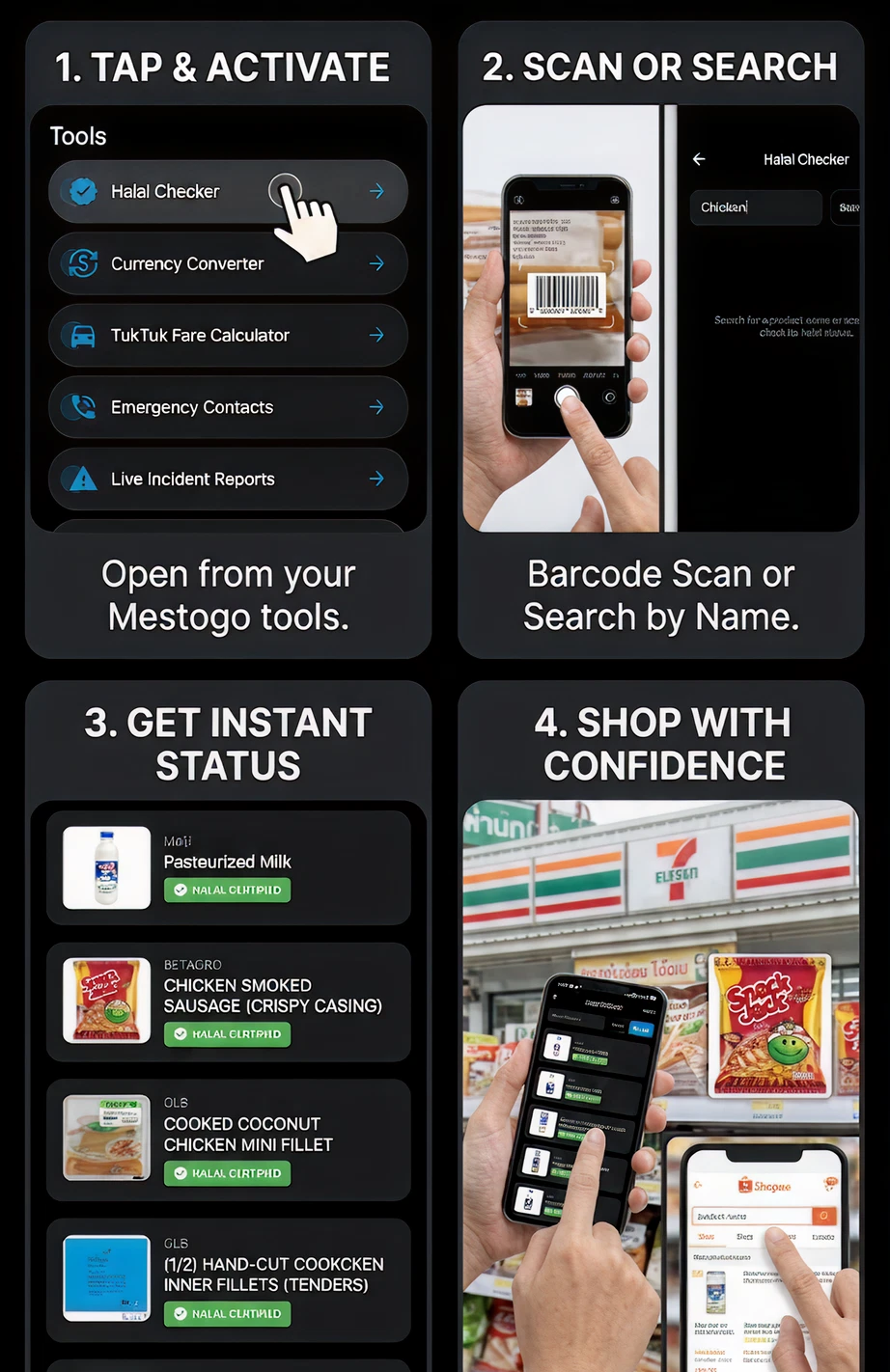
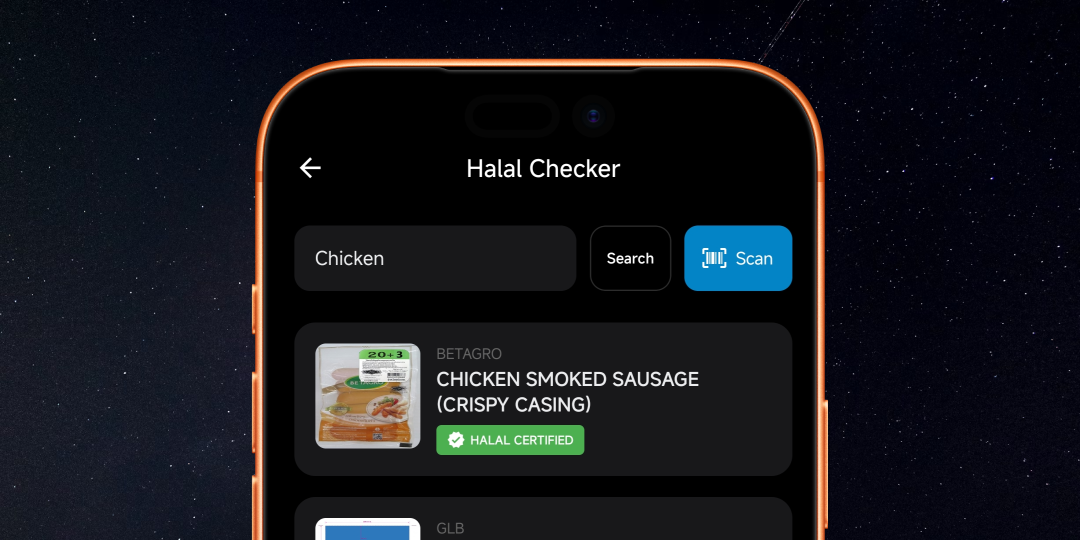
One genuinely useful example is MestoGo’s Halal Checker. Instead of forcing you to decode labels product by product, it lets you either scan a barcode or search by name and quickly check halal-certified products across Thailand. That is especially practical in everyday places travelers actually use, like 7-Eleven, Big C, Tops, and Makro. It is also handy before you buy online, because you can confirm the same product before ordering through Shopee or Lazada.
Level 3: judgment-call street food
Street food is where travelers either have a great experience or burn a lot of mental energy. If the stall has no halal sign, unclear ingredients, shared grills, or sauces you cannot identify, move on. Thailand has too much food to force a doubtful meal.
How to handle prayer during long sightseeing days
The cleanest strategy is to stop thinking of prayer as something you will “fit in somewhere.” In Thailand, it works better when prayer shapes the route a little.
Plan each sightseeing day around:
- one reliable lunch point
- one reliable prayer point
- one fallback indoor location such as a mall, airport, or major transport hub
This matters most in Bangkok. A day that looks compact on the map can stretch because of traffic, station transfers, and heat. If you leave your accommodation without a prayer plan, you may end up choosing between rushing, backtracking, or praying in a space that feels uncomfortable.
Suvarnabhumi Airport’s official site specifically notes Muslim prayer rooms in SAT-1, alongside meditation rooms and baby-care facilities. That is a useful example of a broader Thailand lesson: large travel infrastructure is often easier than improvised neighborhood logistics.
This is also where smart translation helps more than travelers often expect. If you need to ask, “Is this food halal?” or “Is there a Muslim prayer room?”, a context-aware translation tool is much better than a literal word-for-word converter. MestoGo’s Smart Translation feature is useful here because it aims to phrase your message the way a native Thai speaker would naturally say it, which usually makes your request easier for local staff to understand. It also includes a full-screen large-text view, so you can simply show the translated sentence on your phone when speaking is awkward or the environment is noisy.
Transport choices that reduce friction
Muslim-friendly travel is not only about food. It is also about not getting stranded far from the places that make your routine easier.
- In Bangkok, rail-connected areas are easier than scenic-but-isolated stays.
- When you book island or beach days, check return transport times before you leave, not after dinner.
- If you are planning Friday around Jumu’ah, keep your schedule lighter than usual and avoid cross-city transfers right before prayer time.
For some travelers, paying a little more for a more central hotel saves more stress than hunting for a cheaper property on the urban edge.
Hotel red flags to watch for
A hotel is not automatically Muslim-friendly because it says it serves halal food. Look more closely if:
- staff cannot explain whether the kitchen is serving halal meals or just “no pork”
- breakfast staff seem unsure which dishes are prepared separately
- the property is far from both transit and neighborhood food options
- they promise a prayer space but cannot describe where it is
The best Muslim-friendly hotels are not always luxury hotels. Often they are simply the places with staff who answer clearly and understand what you are asking.
If you are checking in late, tired, or dealing with a language gap, smart translation can do a lot of work here too. Showing a polished Thai sentence in large text is often the fastest way to ask for halal breakfast details, nearby mosque directions, or a quiet place to pray without turning the conversation into a long back-and-forth.
A sample low-stress Thailand day
If you are new to Thailand, a smooth day often looks like this:
Start with breakfast at the hotel only if the halal answer is clear. Head out with water, a small prayer kit, and one backup snack you already trust. Do your first sightseeing block near a transit line. Eat lunch in a mall, known halal restaurant, or verified local spot. Keep one saved mosque or indoor fallback nearby for prayer. In the evening, experiment more if you want to, but only after your main needs are already covered.
If you use MestoGo, this is the kind of day where both tools quietly earn their place: Halal Checker for the snack, drink, or supermarket decision, and Smart Translation for the moment you need to ask a vendor, driver, or hotel staff member something sensitive and want it phrased naturally in Thai.
That rhythm sounds simple, but it is what turns Thailand from “possible but tiring” into genuinely enjoyable.
The real takeaway
Thailand is a good Muslim-friendly destination for travelers who value flexibility more than perfection. You are not arriving in a country where every meal and every prayer stop is pre-packaged for you. You are arriving in a country where the support system exists, but you still need to use it intentionally.
If you prepare your tools, choose your base carefully, and make a few smarter daily decisions, Thailand becomes much easier than its surface-level uncertainty suggests.
Related Articles
How Thailand's Halal Certification Really Works: What Travelers Can Trust, Check, and Still Need to Ask
A practical guide to Thailand's halal certification system for travelers who want to understand what the official mark means, how to verify products, and where certification still leaves gray areas.
Why Most Halal Food Apps Fail at Thai 7-Elevens (And the Free One That Works)
We tested 11 halal food checker apps in Thailand. Most can't scan barcodes at 7-Eleven or verify Shopee products — except one free app that does it all.

Suvarnabhumi Airport Hacks: From 'Golden Land' to City in 45 Minutes
Navigate Suvarnabhumi Airport (BKK) in Bangkok with ease. This comprehensive guide covers arrivals, departures, transportation, facilities, and essential tips for a smooth journey.
The Bangkok MRT Rules Tourists Keep Breaking (Without Knowing)
Master Bangkok's MRT with our etiquette guide. Learn queueing rules, seat etiquette, noise policies, and rush hour tips for a smooth, respectful ride.