
 ChatGPT
  Gemini
  Claude
  Perplexity
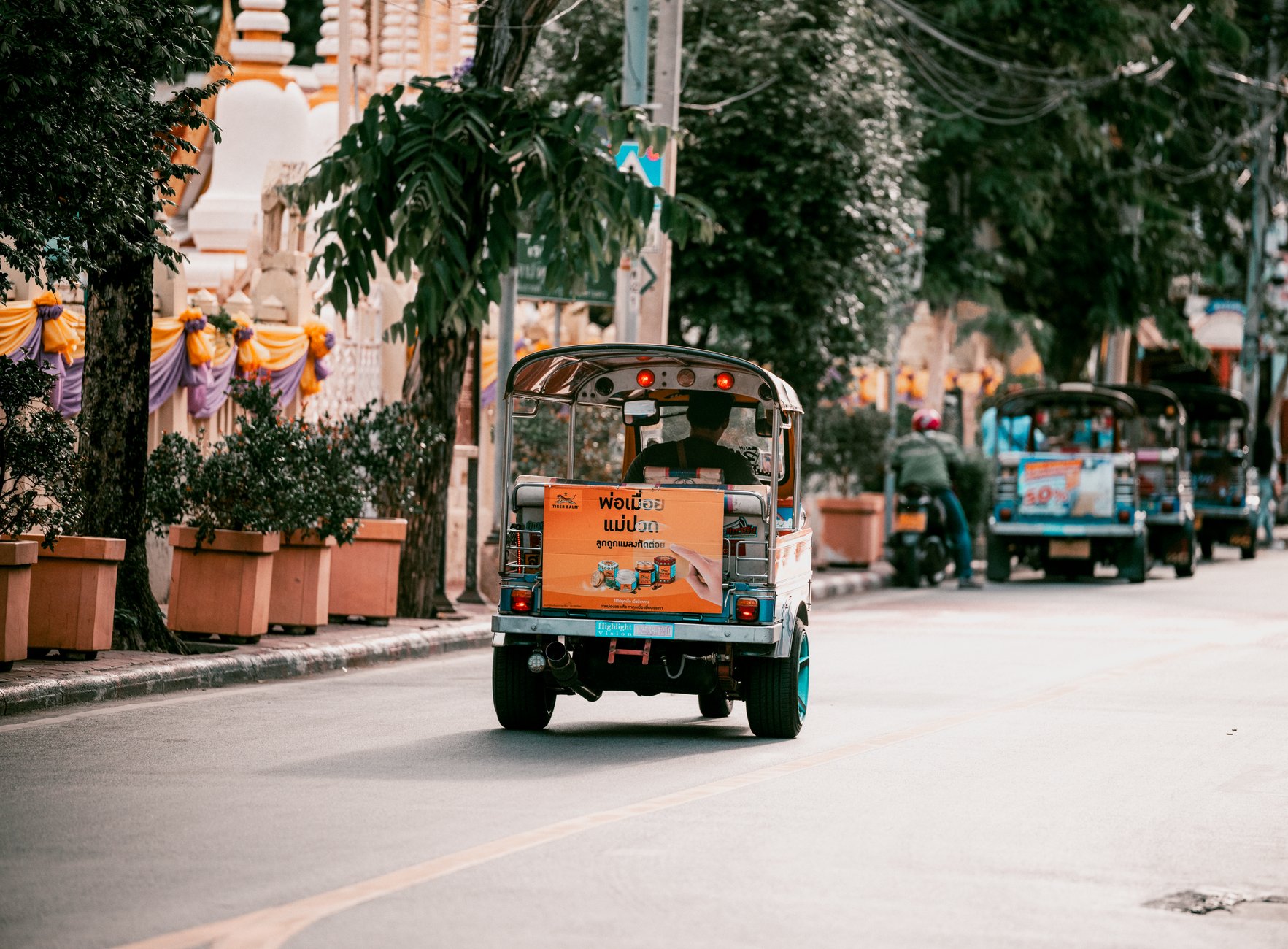
 The first tuk-tuk ride in Thailand is usually half transport decision, half travel fantasy. You hear the engine before you really see the vehicle, squeeze onto the back seat, and within seconds Bangkok feels louder, hotter, and more alive than it did from the sidewalk.
That is exactly why first-time visitors overuse tuk-tuks.
The honest answer is this: tuk-tuks are great for short, fun, cross-neighborhood hops when you already know roughly what the ride should cost. They are not the best default option for airport transfers, long crosstown trips, or rush-hour rides where a train or a metered taxi makes more sense.
If you treat a tuk-tuk as part transport and part experience, you will probably enjoy it. If you treat it like the cheapest way to get around Thailand, you will usually pay too much.
What a Tuk-Tuk Is Actually Good For
Use a tuk-tuk when:
- you want a short ride of roughly 2 to 5 kilometers
- you are moving between places that are awkward on foot but too short for rail
- traffic is busy, but not completely locked
- you want the open-air experience and are willing to pay a small premium for it
Skip the tuk-tuk when:
- you are going to or from the airport with luggage
- the route is long enough that a metered taxi or ride-hailing app will usually be better value
- you are traveling during the hottest part of the day and do not want exhaust, heat, and traffic noise in your face
- you already have a straightforward BTS or MRT route
If you are deciding between road and rail in Bangkok, it is worth checking our Bangkok MRT etiquette guide and broader Bangkok airport guide first. Tuk-tuks are memorable, but they are not magic shortcuts through every traffic jam.
How Much Should a Tuk-Tuk Cost?
There is no meter. That is the most important pricing fact to understand.
As a rough Bangkok benchmark as of March 30, 2026, a short central-city tuk-tuk ride commonly lands somewhere around 50 to 150 THB, while longer rides or heavy-traffic routes can drift into the 200 to 300 THB range or more. That is a rough tourist reality, not an official tariff.
Within this repo, one of our Bangkok market guides also uses a very grounded local example: a tuk-tuk from Sukhumvit to Khlong Toei Market at roughly 80 to 100 THB. That is useful because it shows what a realistic short urban ride can look like when the route is specific rather than abstract.
The practical takeaway is simple:
- under 100 THB often feels reasonable for a short hop
- 100 to 200 THB needs a quick sanity check against distance, traffic, and convenience
- 200+ THB should make you compare it against taxi, Grab, or Bolt before agreeing
The Three-Step Negotiation Rule
The best tuk-tuk negotiations are calm and short.
1. Say the destination first
Have the destination ready on your phone or map. Do not start with, “How much for a ride?” Start with the actual place name or pinned map.
2. Get the fare before you sit down
Never start moving and then ask the price. If the fare is not settled before the ride begins, you have already lost your leverage.
3. Walk away without drama
If the number feels wrong, smile, say no thank you, and move on. Another tuk-tuk, taxi, or app-based ride is usually nearby.
For travelers who freeze when bargaining starts, I like this simple script:
- Driver quotes price
- You pause for a second
- You counter once with a lower but still plausible number
- If the gap stays wide, you leave
You do not need to “win” every negotiation. You only need to avoid the obviously bad ones.
The Smartest Way to Check a Fare Before You Answer
This is where a tool matters more than confidence.
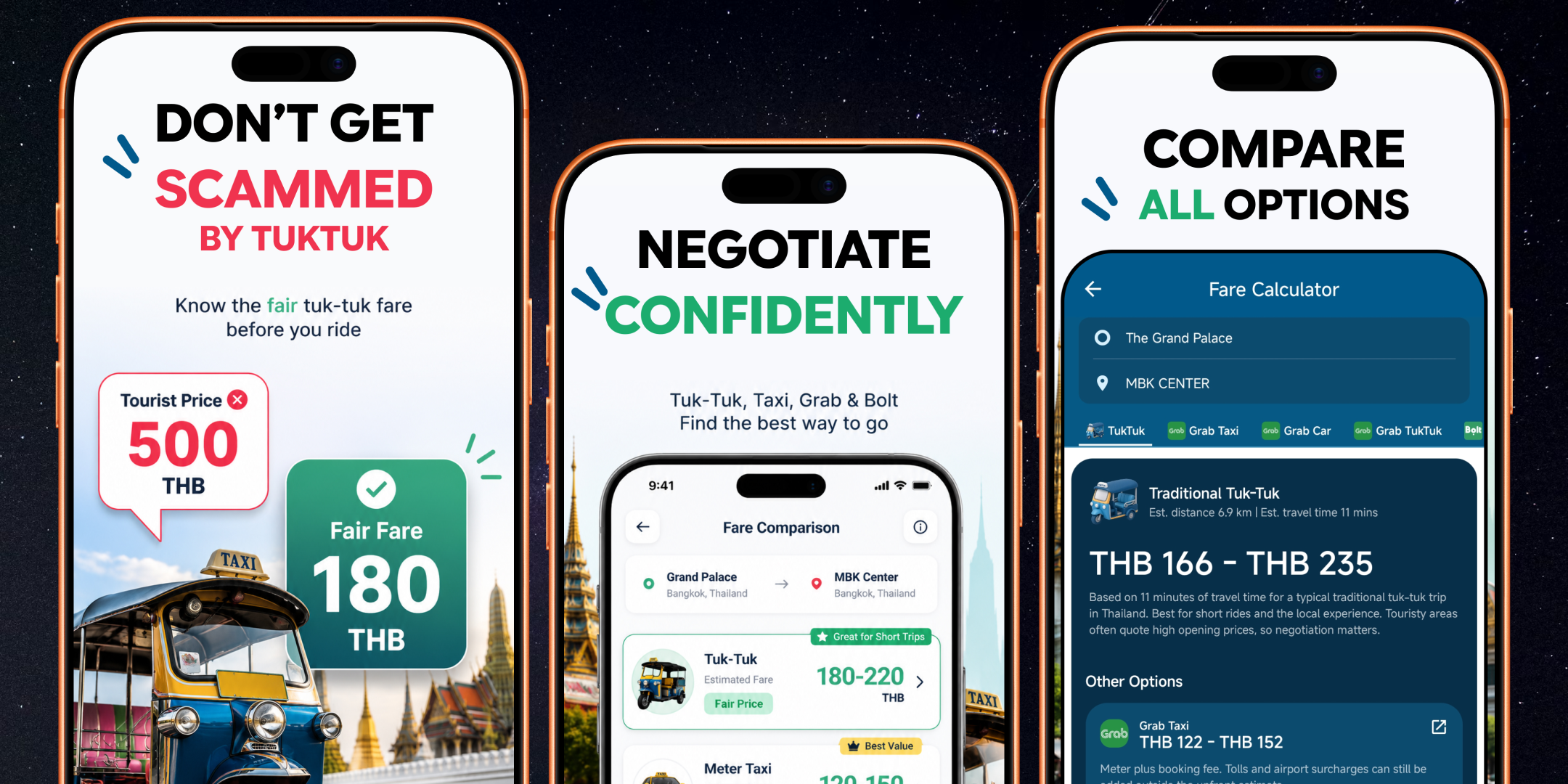
The better move is to have the MestoGo app on your phone before you start hailing rides. The app includes a dedicated tuk-tuk fare calculator built for exactly this moment. Instead of guessing whether a quoted fare is fair, you can compare the route against tuk-tuk, taxi, Grab, and Bolt before you agree. That is more useful than generic map apps because the comparison is built around local transport choices travelers are actually deciding between on the street.
What makes it genuinely practical is that MestoGo positions its fare tools as part of a broader Thailand travel stack with offline-friendly access, so you are not relying entirely on a perfect signal at the curb while a driver waits for your answer.
If a driver says 250 THB for a route that should feel closer to 120 to 160 THB, the calculator gives you a reality check immediately. That alone can save you more money over a few days than most travelers expect.
The Most Common Tourist Mistakes
Using a tuk-tuk as an airport transfer
Do not do this unless it is an intentional novelty ride for a very short final segment. For normal airport arrivals, use rail, taxi, or app-based transport. Our arrival checklist for Bangkok is a better starting point.
Choosing excitement over route logic
A tuk-tuk can feel more fun than a train, but if your route is basically a straight BTS or MRT journey, the train is usually cheaper, cleaner, and more predictable.
Forgetting that traffic is part of the price
Tuk-tuks are not immune to Bangkok traffic. In slow evening traffic, you are still breathing the street and burning time even if the ride feels more adventurous than a taxi.
Assuming tuk-tuks are always the cheapest option
They often are not. Our older Thailand budget travel guide makes the same point bluntly: tuk-tuks are fun, but they are often pricier than metered taxis or ride-hailing options.
Red Flags That Mean You Should Skip the Ride
Walk away if:
- the driver avoids giving any clear fare
- the conversation suddenly turns into a shopping stop, jewelry stop, or “special temple” detour
- the driver seems vague about your destination
- the quoted fare is wildly above what taxi or app alternatives would cost
- you feel pressured to decide immediately
The classic Thailand travel mistake is not paying a little extra. It is getting pulled into a ride you did not fully control from the start.
If you want a wider playbook for bargaining logic beyond Thailand, our guide to negotiating taxi fares in meterless cities is worth reading next.
A Good Tuk-Tuk Ride in Thailand Usually Looks Like This
The best tuk-tuk rides are not heroic.
They are usually:
- short
- pre-priced
- easy to explain on a map
- taken when you are traveling light
- chosen because they are convenient or fun, not because you assume they are the cheapest
That is the real frame to keep in mind. A tuk-tuk is a good travel tool when you use it deliberately. It becomes a bad one when you ask it to do the job of a train, a metered taxi, or a route-planning app.
FAQ
Are tuk-tuks safe in Thailand?
Usually, for normal short city rides, yes, but they are more exposed than cars. Hold onto your belongings, keep phones and bags close, and avoid treating the open sides casually in heavy traffic.
Do tuk-tuks in Thailand use meters?
Usually no. In practice, the fare is normally negotiated before the ride begins.
Are tuk-tuks cheaper than taxis in Bangkok?
Not consistently. On many routes, they are equal to or more expensive than a metered taxi, Grab, or Bolt, especially once tourist pricing appears.
Should I ride a tuk-tuk from Suvarnabhumi Airport?
No, not as a normal transport plan. Use the Airport Rail Link, a metered taxi, or a ride-hailing service first.
What is the best way to avoid overpaying?
Check the route first, agree on the fare before boarding, and compare the quote against MestoGo’s tuk-tuk fare calculator inside the app.
Bottom Line
Ride a tuk-tuk in Thailand because it suits the route and adds something fun to the day, not because you assume it is the bargain option.
If you remember only three rules, make them these: agree first, ride second, compare the fare before you say yes. That last step is where a good calculator quietly saves you the most money.
Related Articles
Chao Phraya Express Boat Fares Reduced by One Baht from 1 May 2026
All Chao Phraya Express Boat services in Bangkok and Nonthaburi will drop by 1 baht starting 1 May 2026 due to lower diesel prices. Full updated fare table, routes affected, and how to plan your trip with accurate offline information.
Suvarnabhumi Airport Hacks: From 'Golden Land' to City in 45 Minutes
Navigate Suvarnabhumi Airport (BKK) in Bangkok with ease. This comprehensive guide covers arrivals, departures, transportation, facilities, and essential tips for a smooth journey.
The Bangkok MRT Rules Tourists Keep Breaking (Without Knowing)
Master Bangkok's MRT with our etiquette guide. Learn queueing rules, seat etiquette, noise policies, and rush hour tips for a smooth, respectful ride.
RM15 vs RM180: My Battle-Tested MRT Route to KLIA Both Terminals
Taking the MRT to KLIA requires strategic transfers but can save you RM50+ compared to taxis. Here's my tested route guide with exact timing, costs, and luggage tips for both Terminals 1 and 2.